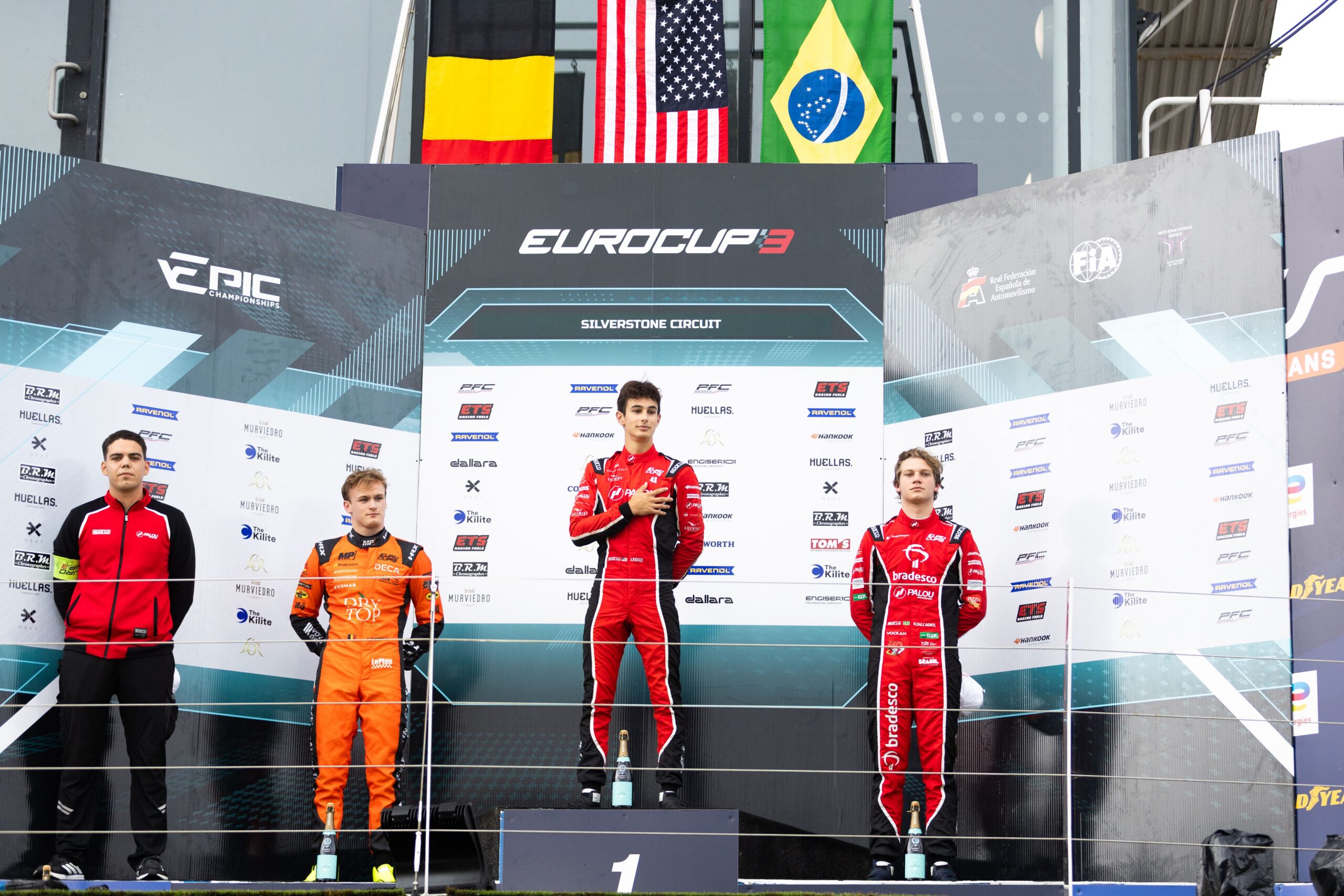
Line up the 2026 Eurocup-3 grid and you’ll hear Portuguese, Polish, Thai, Arabic, English, Greek and Spanish in the paddock, often all at once. This season, 44 drivers from 19 nationalities have raced in the championship, with entrants from the United States, Brazil, Australia, Thailand, Lebanon, Belgium, Poland, Greece and more.
That’s unusual for a series that only started in 2023. So why do young drivers from five continents keep choosing Eurocup-3 as the next step in their careers? Here are the main reasons.
A Calendar Built on Europe’s Most Iconic Circuits
For a young driver, track knowledge is a career asset. The circuits you master in junior categories often show up again in Formula 3, Formula 2 and beyond.
The 2026 Eurocup-3 calendar runs across six countries on some of the best-known venues in motorsport:
- Circuit Paul Ricard (France)
- Algarve International Circuit, Portimão (Portugal)
- Imola (Italy)
- Monza (Italy)
- Silverstone (United Kingdom)
- Circuito de Jerez (Spain)
- Hungaroring (Hungary), 23–25 October
- Circuit de Barcelona-Catalunya (Spain), 6–8 November
Silverstone, the Hungaroring and Imola are on the calendar for the first time this year. Few junior championships can offer this mix of Grand Prix circuits, and for drivers coming from outside Europe, it’s the quickest way to learn the tracks that matter.
Next-Generation Machinery
In 2026 Eurocup-3 moved to its second generation of technical regulations, introducing the new Dallara 326 chassis. Drivers get a modern, competitive single-seater that prepares them for the demands of higher categories, from aerodynamic sensitivity to tyre management on Hankook rubber.
A single, controlled technical package means everyone starts from the same base. Results come down to the driver and the team, and that’s the kind of fair test talent scouts and junior programmes want to see.
Competitive Costs, Professional Standards
One of the reasons Eurocup-3 was created was to offer a cost-effective route up the single-seater ladder without cutting corners on quality. A capped team budget keeps the championship within reach for more drivers and families, while the series keeps a professional standard on and off track.
For drivers based outside Europe, who also have to cover travel, relocation and living costs, that balance between cost and quality is often what makes the decision.
Top Teams Behind Every Car
Nine teams are on the 2026 grid, including well-established names in the junior single-seater world such as Campos Racing and MP Motorsport. These teams bring engineering know-how, data analysis and driver-development experience that young drivers often can’t find in their home countries.
For an Australian or Brazilian teenager making the move to Europe, joining a structure like this means more than a seat. It means a support system that helps them adapt fast.
A Proven Record of Champions from Everywhere
Eurocup-3’s short history already shows how open it is. Every champion so far has come from a different country:
- 2023: Esteban Masson (France)
- 2024: Christian Ho (Singapore)
- 2025: Mattia Colnaghi (Italy)
- 2026: James Egozi (USA)
Two Europeans, an Asian and an American. The message to drivers around the world is clear: you can come here from anywhere and win.
Winter Racing: A Head Start on the Season
The championship’s ecosystem includes the Eurocup-3 Spanish Winter Championship, held between February and March. It gives drivers extra track time on Spanish circuits before the main season starts, which is a real advantage for anyone new to European racing.
In 2026, Keanu Al Azhari took the Winter title, René Lammers won the rookie standings and Campos Racing claimed the teams’ crown. Many drivers use the winter series to adapt to the car, settle in with their team and arrive at the first round of the main season ready to fight.
Visibility for Drivers, Their Families and Their Sponsors
Racing internationally only works if people back home can follow along. Eurocup-3 offers broadcasts, live timing and an active social media presence, so fans, families and sponsors in any time zone can watch their driver race at Monza or Silverstone.
For drivers looking for backing, that global exposure makes a real difference. It turns a race weekend in Europe into content for a sponsor in São Paulo, Bangkok or Beirut.
The Bigger Picture: A Global Paddock
The international mix isn’t just a statistic; it shapes the championship. Drivers learn to compete against different racing styles, work with engineers in a shared language and build a network of contacts that will follow them through their careers. Many of the people they race against today will be the ones they meet again in Formula 3, Formula 2 or endurance racing.
That’s the real appeal of Eurocup-3: a demanding, fair and international platform where young drivers can prove themselves on the tracks that count.
Catch the final rounds of the 2026 Eurocup-3 season at the Hungaroring (23–25 October) and the season finale at Circuit de Barcelona-Catalunya (6–8 November).